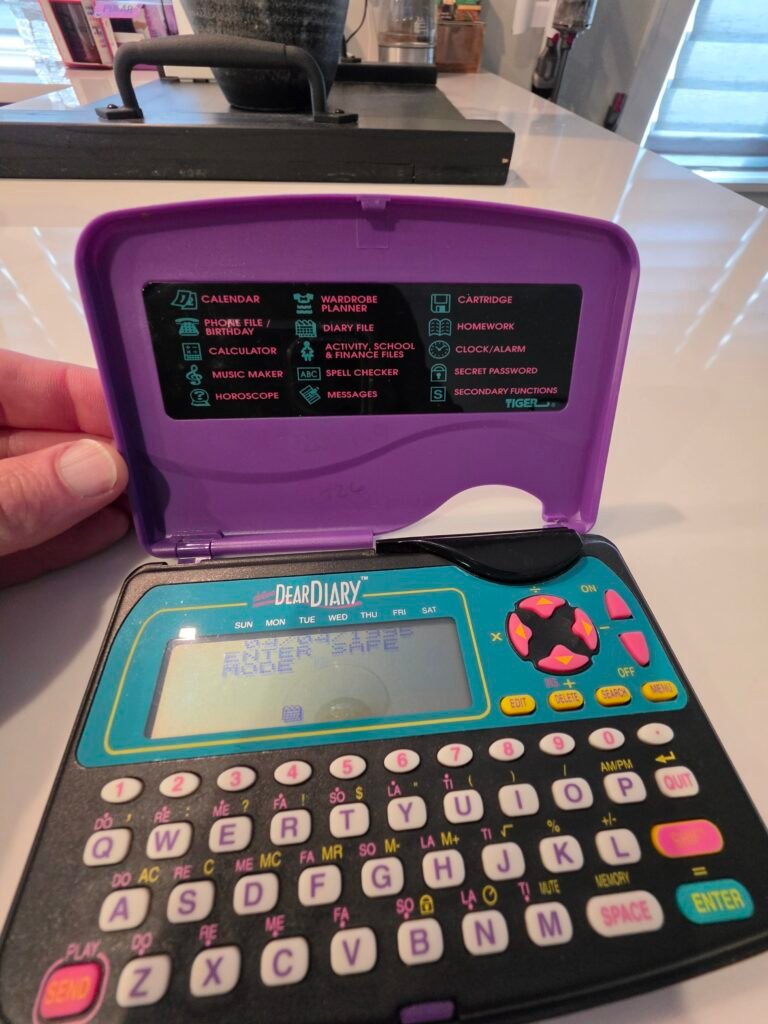
The 1995 Tiger Electronics Deluxe Dear Diary is a chunky plastic clamshell with a screen you have to squint to read. But in an era of constant cloud data breaches, this offline, PIN-protected 90s toy has become my ultimate “Slow Tech” secret weapon for storing emergency passwords and capturing distraction-free thoughts.
I am sitting in my home office, staring at my computer monitor. I just got another email from a massive tech conglomerate politely informing me that my data “may have been involved in a security incident.” Yay. Another empty offer of “free credit monitoring.”
If I were relying solely on the cloud, I would be panicking right now. I’d be scrambling to change my master passwords and double-checking my two-factor authentication apps, trapped in a modern web of cybersecurity anxiety.
Instead, I open my desk drawer. I pull out a chunky, neon plastic clamshell. I pop the lid, type in a 4-digit PIN on a rubbery keyboard, and stare into a murky, unlit LCD screen.
This is the 1995 Tiger Electronics Deluxe Dear Diary. It does not have end-to-end military-grade AES-256 encryption. It has a piece of plastic that snaps shut. And yet, it is ironically one of the most secure piece of technology I own.
If you want to take your digital security and privacy back into the physical world, it’s time to raid your childhood bedroom.
The Hardware: Plastic, Squinting, and Battery Anxiety
Let’s be brutally honest about the hardware: this thing was built for an eight-year-old in the mid-90s, and it shows.
The keyboard is that classic, squishy rubber membrane that requires you to press dead-center with your fingernail to register a letter. The screen is a dot-matrix LCD with absolutely zero backlight. If you aren’t sitting directly under a bright incandescent lamp, you are going to be squinting.
Then there is the battery life. It runs on a CR2032 coin battery. Because the memory is volatile, if that battery dies, your data dies with it. When the “low battery” warning flashes, you have exactly the amount of time it takes to unscrew the back plate and hot-swap the battery before your diary is wiped clean. It is a terrifying, analog thrill.
Peak 90s Features
Beyond the nostalgia trip, there are legitimate, everyday uses for this device in 2026.
- Distraction-Free Brain-Dumping: When my brain is spinning and I just need to get a thought out, I type it here. There is no backspace latency, no red squiggly lines judging my grammar, and zero chance of accidentally opening Instagram.
- The Oracle (Horoscopes & Fortune Telling): The Deluxe Dear Diary comes with a built-in horoscope and fortune-telling feature. Is it just a randomized algorithm on a 30-year-old chip? Yes. Is it incredibly charming to have a plastic brick tell you that your lucky number today is 4? Absolutely.
But here is the feature nobody talks about and everybody should: the built-in horoscope and fortune-telling function. Yes. This chunky neon brick contains a randomized oracle. You press a few keys, answer some deeply serious prompts about your star sign and your current mood, and a device running on technology older than most of my houseplants delivers your fate in eight words or fewer on an unlit LCD screen.
The Secret Weapon: The Ultimate “Cold Storage”
Here is the real reason this device sits in my desk drawer. It is the ultimate offline password manager.
My wife and I have a system. We need a shared, physical backup for our most critical digital locks—bank accounts, master passwords, home security PINs—just in case something happens to me or LastPass goes down in flames. Writing them in a paper notebook feels reckless. Storing them in a Google Doc is basically leaving the front door open.
So, they go into the Dear Diary. I store them cryptically (using hints that only she and I understand), locked behind the device’s physical PIN code. It is entirely air-gapped. A Russian hacker cannot infiltrate my network and extract my Dear Diary data. It is physically impossible.
It is “Cold Storage” in its purest, most ridiculous form.
Pros & Cons of Vintage Electronic Diaries
Pros:
- 100% Air-Gapped: You cannot hack what is not connected to the internet.
- Zero Notification Fatigue: It will never buzz to tell you the news. It just waits for you to type.
- PIN Protection: A genuine layer of physical security that a paper notebook simply doesn’t have.
- Nostalgia Dopamine: The beeps, the plastic, the font—it is a pure hit of 1995 joy.
Cons:
- Volatile Memory: If the battery dies completely, your data is gone forever. You must be proactive about changing the CR2032 battery.
- Abysmal Screen: No backlight means you are at the mercy of the sun and room lighting.
- Slow Input: You will not be typing out the next great American novel on these tiny rubber keys. It is for short notes only.
The Verdict
We have spent the last decade trusting the cloud with our deepest secrets and our most sensitive keys, only to realize the cloud is just a server in Nevada that gets breached twice a year. Sometimes, the smartest technological move is a massive regression. Grab a 1995 Tiger Electronics Dear Diary. Lock it with a PIN. Let your secrets live offline again.
Frequently Asked Questions
Does the Tiger Electronics Dear Diary have a backlight? No. Like most 90s LCD tech, there is no internal light. You will need a well-lit room or a flashlight to read the screen clearly.
What happens if the battery dies? The Dear Diary uses volatile memory. If the main battery dies, your saved entries and passwords will be erased. You must replace the battery quickly when the low-power indicator comes on to preserve your data.
How secure is the PIN? It requires a custom password to unlock the diary functions. While it won’t stop a determined hardware engineer from tearing the device apart, it will absolutely stop a nosy roommate, a child, or a casual thief from reading your notes.