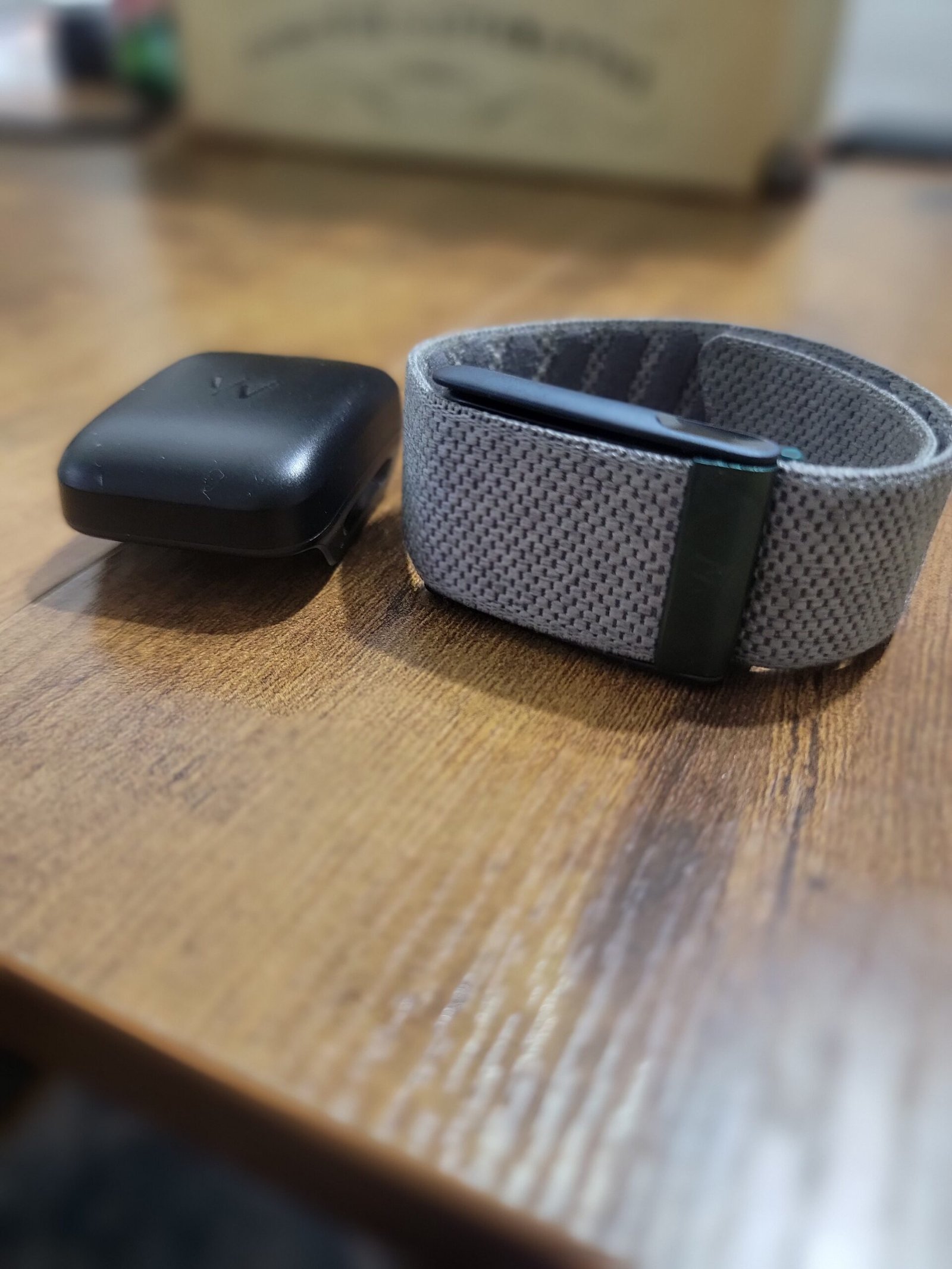
This review is for people who want health data without turning their wrist into another screen.
As a marketing exec and passionate creative, I live a data-driven life. I have dashboards for spend, spreadsheets for ROI, and analytics for this very blog. I might even have a chart for tracking ridiculous expenses. Information is everywhere.
Most modern wearables deliver health data like the Vegas Strip: they buzz, they light up, they make demands. They turn your biological metrics into just another notification competing for your awareness.
I need the data, but I despise the distraction.
I have been wearing a Whoop for over five years, recently upgrading to the Whoop 5.0 with EKG. It is a strap. That’s it. No screen. No buttons. No lights.
It creates a boundary that modern tech has forgotten: The data exists, but only when I ask for it.
The Specs
- Device: Whoop 5.0
- Release Date: 2025
- Price: Subscription Model (approx. $239/year)
- Distraction Level: 0% (No Screen, No Haptics for Notifications)
- Battery: 4-5 Days (Charge while wearing)
- Key Feature: EKG & Health Monitor
My “Safe Mode” Ritual: Mantra First, Data Second
Before we get started, I will fully acknowledge that this is a polarizing device. We can debate the merits of the Whoop’s data accuracy and the subscription pricing model, but that’s what Reddit is for. I’m a fan because the Whoop doesn’t push data to me, aside from a subtle notification when my sleep data is processed…and even that I usually disable.
I have to prompt it. This allows me to wrap the device in a very specific morning ritual.
When I wake up, I don’t immediately grab my phone to check my “Recovery Score.” First, I take a few deep breaths. I repeat my personal mantra in my head several times. I check in with my body before I check in with the cloud.
Only then do I open the app.
Usually, it validates exactly how I feel—a red recovery score confirms why I’m groggy. But sometimes, it throws me into a tizzy. I’ll wake up feeling strong and rested, only for the device to tell me I’m at 34% recovery. In the early days, this would ruin my mood (the “Nocebo” effect). But over the years, I’ve learned to use the data as a guide, not a god. I listen to my instincts first.
The 5.0 Upgrade: Why EKG Matters
I’ve had the Whoop 3.0, the 4.0, and now the 5.0, accumulating a drawer full of useless bands along the way. The jump to the 5.0 added an EKG sensor, which might sound like overkill for a non-athlete, but for me, it adds to the “Safe Mode” philosophy.
The EKG allows for more precise heart rhythm tracking. It acts as a silent background bodyguard. Knowing that I have medical-grade monitoring happening without a scree, on-demand, reduces my anxiety rather than increasing it. Overall, the Whoop is “set it and forget it” health monitoring.
Five Years of Whoop Data
After wearing this strap for over 1,800 days, the novelty of “tracking” has worn off, replaced by genuine behavioral change. The Whoop doesn’t just record history; it changes the future by forcing me to deal with the biological cost of my choices. I can’t tell you how many times I’ve passed on a random beer in order not to throw off my numbers!
The “Green” Days vs. The “Red” Days
The core metric Whoop uses is Heart Rate Variability (HRV)—the variation in the time between heartbeats. High variability indicates your nervous system is balanced and ready to perform. This # is unique to each person, but helps you establish a baseline.
- When I’m Green: I push. I know my body can handle a heavier pickleball session or a longer Peloton session.
- When I’m Red: I back off. I make it a priority to sleep and skip the workout. This prevents the “overtraining” burnout that used to plague my 30s.
The Lifestyle Insights
Over five years, the data has ruthlessly quantified my bad habits. It is no longer a vague notion that “late meals are bad”; I have the data to prove it.
- The Late Meal Penalty: If I eat a heavy meal within 3 hours of bed, my recovery score tanks by 15-20%. My body spends energy digesting instead of recovering.
- The Hydration Correlation: On days I hit my water goals, my HRV is consistently 10% higher. The device acts as a constant, silent reinforcement of these basics.

The “Illness Radar”: Technical Accuracy
The most “magical” (and technically impressive) feature is the illness prediction.
Whoop tracks Respiratory Rate (breaths per minute) with scientific exactness. While data points such as Resting Heart Rate may vary because of to stress or bad sleep, Respiratory Rate is incredibly stable—usually staying within 0.5 breaths per minute every single night.
When that number spikes, it is a definitive red flag. The Whoop has successfully predicted that I was getting sick, often 24 to 48 hours before I felt a single symptom—with near 100% accuracy. It detects the subtle physiological stress your body experiences when fighting a virus before your brain registers the sore throat. This “pre-warning” allows me to start hydrating and resting before the crash hits.
Compared to a standard Fitbit or Apple Watch, which regularly highlight “Activity Minutes,” Whoop’s “Resting Metrics” makes it a far superior diagnostic tool for long-term health.
Impact on Attention
The biggest benefit of the Whoop isn’t the heart rate tracking; it’s the peace.
When I am writing fiction or in a high-pressure meeting, the Whoop is physically unable to interrupt me. It tracks my stress levels and heart rate in the background, but it never taps me on the wrist to tell me about it.
I rarely check the data during the day. The only exception is after a rigorous pickleball session, when I’ll check the app to ensure my heart rate is recovering appropriately. Otherwise, it is an invisible passenger, archiving my health without hijacking my focus.
The Whoop succeeds because it doesn’t try to be your messenger, your wallet, or your music player. It’s a biometric sensor, period. This singular focus is what allows it to disappear into your life rather than dominate it.
Pros & Cons
The Good
- 2% Distraction: It is the only “smart” device I own that respects my attention span.
- The “Illness Radar”: It is incredibly helpful at predicting when a cold or flu is coming days before I feel the symptoms.
- Seamless Charging: You slide a battery pack onto the strap while wearing it, so you never have “data gaps.”
The Bad
- Subscription Model: You never technically “own” the device; you rent the service.
- The “Psych Out”: Seeing a low recovery score on a big day can mentally sabotage you if you aren’t careful.
- No “Smart” Features: If you want to check the weather or change a song, you’re out of luck.


The Final Verdict: Data on My Terms
We often think “Safe Mode” means rejecting technology, but I think it means subjugating it.
The Whoop represents the ideal relationship between a human and a computer. It is working in the background to help me understand my body, but it knows its place. It understands that my attention belongs to my work, my family, and my friends—not to my wrist.
The data is there seamlessly on my time, when I want to look at it. And not a second before. It’s proof that we can have our data and our sanity too.
FAQ
Is the Whoop subscription worth it? If you are obsessed with data but hate distractions, yes. If you just want a step counter and notification buzzer, a one-time purchase tracker (like Fitbit or Garmin) is cheaper.
Can Whoop send notifications? No. It has no screen and no vibration motor for texts or emails. It is strictly a sensor.
Does the Whoop 5.0 track EKG? Yes, the 5.0 model includes an EKG sensor, enabling heart rhythm.