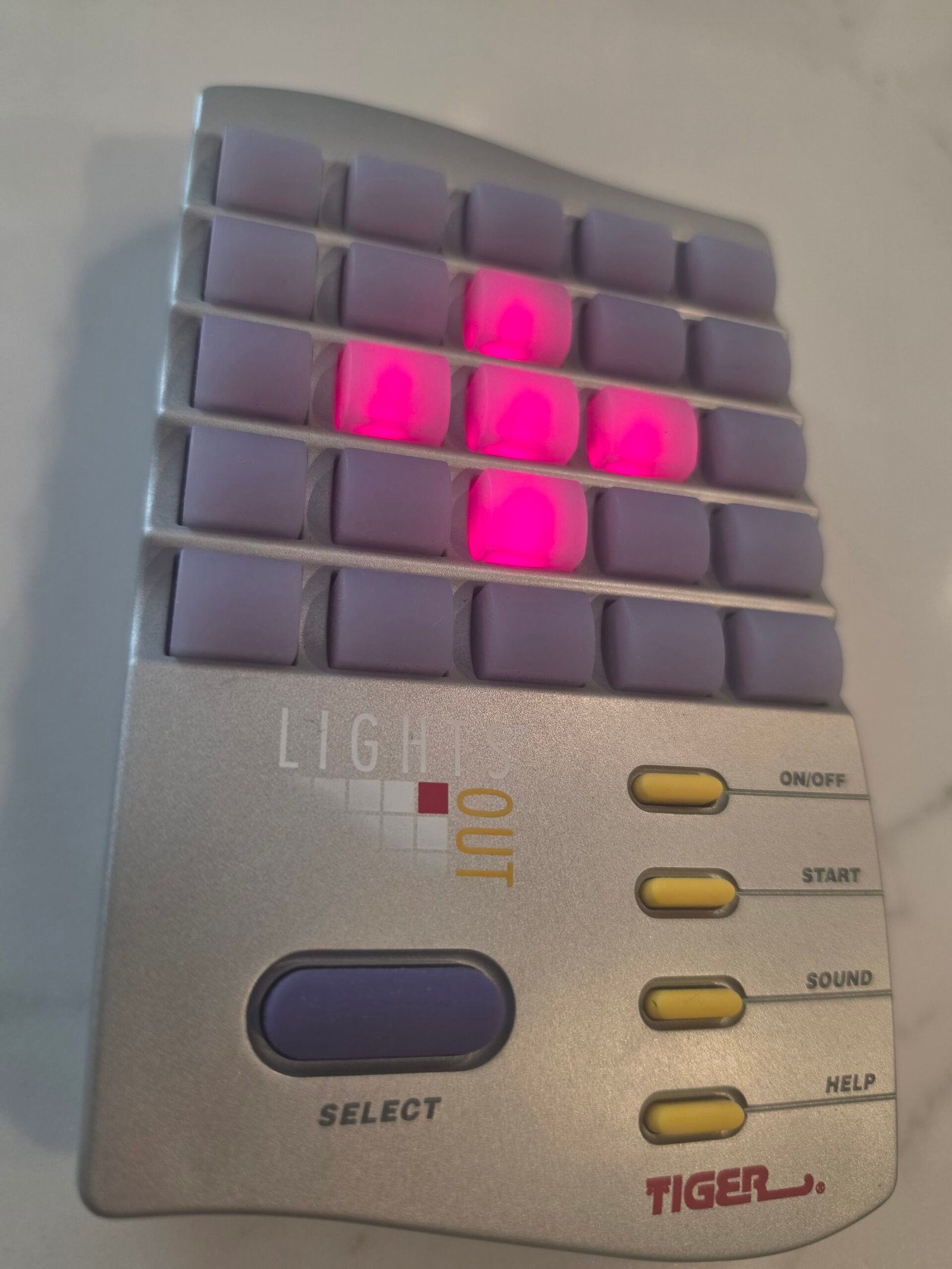
Twenty-five buttons. Twenty-five little red lights.
One seemingly reasonable request: TURN THEM ALL OFF.
How difficult could that possibly be?
Well, in 1995, Tiger Electronics released a handheld puzzle game called Lights Out, and the answer was considerably more difficult than anybody had any right to expect.
There are no characters to control. No monsters to kill. No levels to explore. You don’t need lightning-fast reflexes, a strategy guide the size of a phone book, or the hand-eye coordination of a caffeinated teenager playing GTA VI.
You just need to turn off some lights. Except every time you press a button, you risk turning on several more.
It’s an exercise in controlled frustration, dressed up as a perfectly innocent electronic toy. And it’s also one of the most satisfying examples of single-purpose technology to emerge from the 1990s.
I’m making a strong case for the original Tiger Lights Out as the ultimate handheld mind reset. It gives your brain one wonderfully stubborn problem to work on, and that’s the whole shebang. And those chunky physical buttons and glowing pink? purple? red? squares are a huge part of the attraction.
What Is Tiger Electronics Lights Out?
Released in 1995, Lights Out is an electronic handheld logic puzzle consisting of 25 illuminated buttons arranged in a 5×5 grid.
The objective is simple: turn off every light using as few button presses as possible.
The complication is that pressing one button changes the state of that button AND its immediate neighbors above, below, left, and right.
Lit buttons turn off. Unlit buttons turn on. Diagonal buttons aren’t affected.
Imagine pressing the center button on a completely dark board. Five red lights would illuminate in the shape of a plus sign.
Press the center button again and all five go dark.
So far, so good.
Now imagine starting with a seemingly random arrangement of twelve or fifteen illuminated buttons. You press one, extinguishing three lights. Excellent!
Except you’ve just switched on two others. You press another. Four lights go dark! And three more light up.
Suddenly, the device that appeared to require less intellectual horsepower than operating a microwave is making you question your ability to recognize patterns.
The game isn’t difficult because the controls are complicated. It’s difficult because the controls are ridiculously simple, and every decision affects something else.
Tiger Electronics Actually Built a Beautiful Little Puzzle Machine
There’s something wonderfully peculiar about the design of the original Lights Out.
The gray, slightly curved body looks like a piece of electronic equipment that might have been sitting on somebody’s desk in 1995. The purple and yellow function buttons are unmistakably Tiger Electronics, and above them sits the magnificent 5×5 grid of raised square buttons.
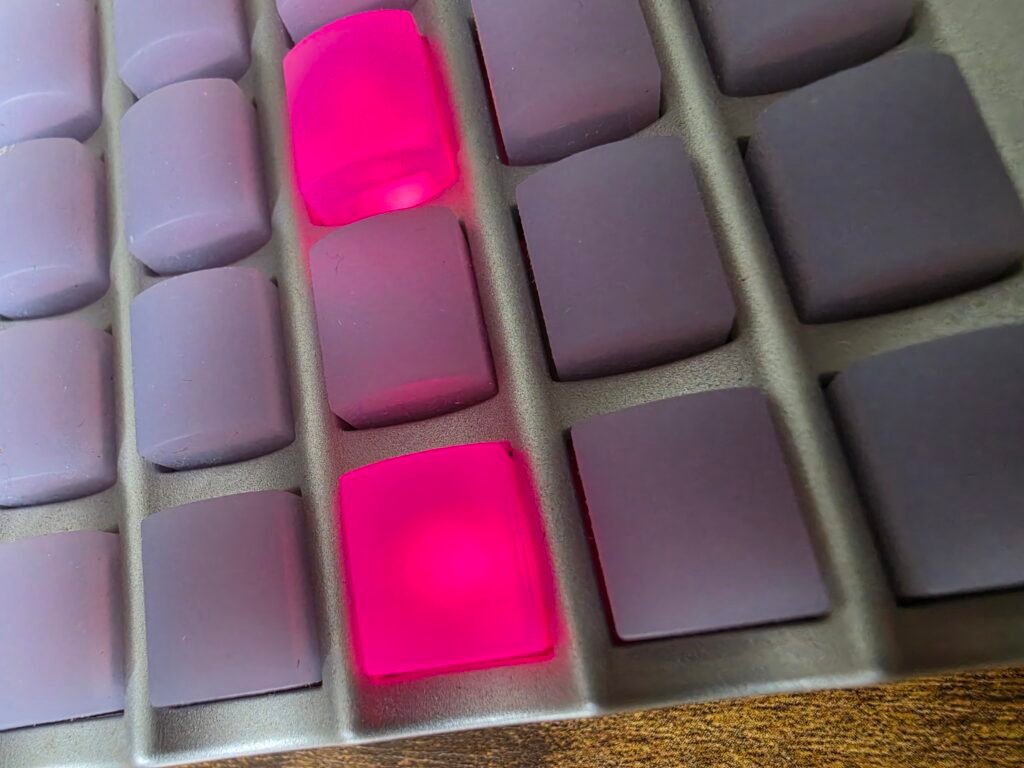
Each square serves two purposes: it’s both an input button and an illuminated display.
You’re pressing the display itself: twenty-five physical buttons that glow red when they’re on. There’s a direct relationship between your finger, the mechanism, and the result.
PRESS.
The lights change.
PRESS.
They change again.
The visual feedback is immediate. And because the lights are embedded in the buttons, there’s no separation between what you’re manipulating and what you’re watching.
This is precisely the kind of tactile interaction that makes older handheld electronics so appealing.
A great physical button doesn’t have to perform a dozen functions. Sometimes its entire job is to be pressed, respond, and make you want to press it again.
And Lights Out gives you twenty-five of them.
The glowing red buttons also have a peculiar visual appeal. When a puzzle starts, the illuminated pattern looks almost decorative. As you progress, that pattern changes, contracts, expands, and occasionally transforms into something considerably worse than what you started with.
The final move is especially satisfying. A button goes down, the remaining lights disappear, and the board is dark.
You did it.
Never mind that you’ve just spent an embarrassing amount of mental energy turning off a few tiny red lights.
Victory is victory.
One Game. Three Modes. Thousands of Headaches.
Lights Out is much more than a single puzzle repeated endlessly.
The original handheld includes three game modes, each approaching the same basic challenge differently.
Mode 1: Fifty Puzzles That Get Progressively Nastier
This is where beginners should start.
Tiger programmed 50 puzzles into the device, arranged in increasing difficulty.
The first five require a minimum of six moves. Every five puzzles, the minimum increases by another move, eventually reaching 15 moves for puzzles 46 through 50.
The progression is deliberate. Early puzzles teach you how buttons interact, while the harder ones demand more planning.
Tiger also cares how efficiently you solve them! Complete a puzzle in the minimum number of moves and the game rewards you with a little light show before advancing.
Take a few extra moves and it’ll tell you how many you wasted. Exceed the minimum by more than ten moves and you have to try again before advancing.
That’s right. Even when all the lights are off, Tiger may decide your performance wasn’t good enough.
Mode 2: More Than 1,000 Randomized Puzzles
Once you’ve made progress through Mode 1, there’s an enormous collection of computer-generated challenges waiting for you.
Mode 2 offers more than 1,000 randomized puzzles, with difficulty tied to the levels you’ve reached in the first mode.
The objective doesn’t change. Neither do the rules.
But the starting arrangements do, which means the game can continue to challenge you long after you’ve memorized a few of the preset solutions.
Mode 3: Make Your Own Puzzle
This is where things get particularly interesting.
Mode 3 lets you create your own starting arrangement of illuminated buttons. You can then attempt to solve it yourself or hand the device to somebody else.
Sounds innocent enough.
Except there’s something Tiger casually acknowledges in the original instruction manual: you can create a puzzle that doesn’t have a solution.
We’ll get to that mathematical cruelty shortly.
How to Solve Lights Out Without Losing Your Mind
The greatest mistake you can make in Lights Out is assuming that every move should immediately reduce the number of illuminated squares.
The objective is to turn lights off, so surely the best strategy is to press whichever button switches off the most lights?
Not necessarily.
A move that turns off four lights might leave you with a much more complicated arrangement. Meanwhile, a move that turns ON three additional lights might be exactly what you need to complete the puzzle.
Lights Out rewards pattern recognition, planning, and an understanding of how individual moves interact.
A few strategies can dramatically change the way you play.
Strategy 1: Stop Chasing Individual Lights
Think of the board as one connected system. Every button affects a small neighborhood. Press a button in the middle and you toggle five positions. Press one along an edge and you affect four. Press a corner button and only three positions change.
This matters because a move’s usefulness depends on where it’s made and which nearby lights are already illuminated.
Instead of asking, “Which light should I turn off?” ask:
“What pattern will this button create?”
Strategy 2: Learn the Power of Cancellation
Here’s an important rule that the game doesn’t make immediately obvious.
Pressing the same button twice cancels out the move entirely.
The first press toggles its group of lights. The second toggles those same lights back.
There’s another useful trick: the order in which you press different buttons doesn’t affect the final result, provided you press the same set of buttons.
Press buttons A, B, and C, or C, A, and B. You’ll end up with the same pattern.
Once you understand this, Lights Out becomes less about finding the correct sequence and more about identifying the correct combination of buttons.
This is why repeatedly hammering buttons until something good happens is a lousy strategy. You’re often undoing your own progress without realizing it.
Strategy 3: Chase the Lights Down the Board
This is the classic Lights Out solving technique, and it’s a game-changer.
It’s called Chase the Lights.
Rather than trying to extinguish random clusters, you systematically work from the top of the grid toward the bottom.
Here’s how it works:
- Look at the top row. For every illuminated button, press the button directly beneath it in the second row.
- Once the top row is completely dark, move to the second row. Press the buttons directly beneath any remaining illuminated squares.
- Continue this process down the board, clearing rows one through four.
- When you reach the bottom, inspect the pattern of lights that remains.
- If lights remain in the bottom row, use the pattern to determine which top-row buttons need to be pressed, then repeat the downward chase.
The first four rows can always be cleared this way.
The catch is that the bottom row might still contain illuminated buttons. That’s where planning your initial top-row moves becomes important.
But even before mastering that final step, you’ve transformed the puzzle from a chaotic guessing game into a repeatable process.
And that is a HUGE improvement.
Strategy 4: Sometimes You Have to Make the Board Worse
One of the most counterintuitive things about Lights Out is that a useful move might temporarily increase the number of illuminated buttons.
This is not necessarily a mistake.
Because every press affects multiple positions, creating new illuminated squares can help set up a later move that clears an entire group.
You need to be comfortable with the board looking worse before it gets better.
That’s an interesting mental adjustment, particularly in a game whose entire objective is to eliminate things.
The red lights aren’t enemies you have to destroy one at a time.
They’re parts of a pattern you need to rearrange.
Strategy 5: Use the Help Button, but Don’t Depend on It
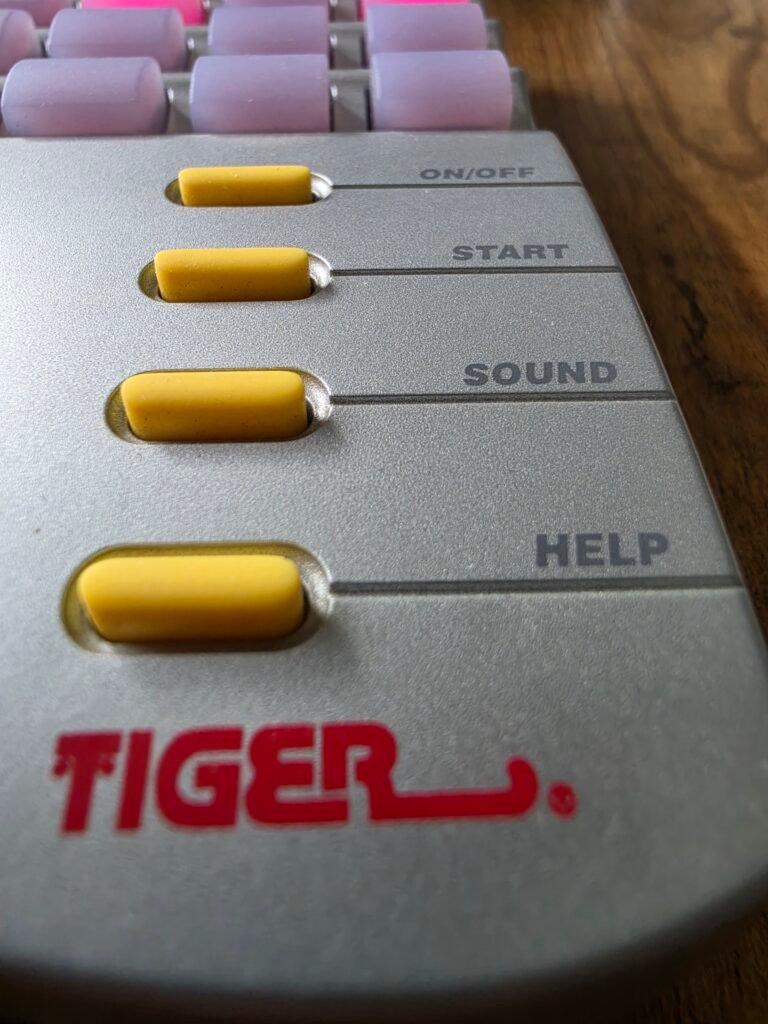
The original Lights Out has a dedicated HELP button.
In the easier puzzles, it can show and automatically perform the first two moves of a solution.
Help is available only for puzzles requiring ten moves or fewer, which includes the first 25 preset challenges. It’s also available on qualifying puzzles in Mode 2.
Once you’ve made your own move, the Help feature becomes unavailable until you restart or complete that puzzle.
And on the harder puzzles?
You’re on your own.
Even Tiger Electronics knew when to stop being helpful.
The Lights Out Bottom-Row Cheat Sheet
For players who want to master the Chase the Lights technique, there’s an additional trick.
After completing your first downward sweep on a solvable standard 5×5 puzzle, the remaining lights on the bottom row will form one of eight possible patterns.
One pattern is completely dark, meaning you’ve already solved the puzzle.
The other seven can be corrected with specific top-row moves.
In this table, 1 means the light is ON and 0 means it is OFF. Read each five-digit pattern from left to right across the bottom row.
| Bottom-row pattern | Top-row buttons to press |
|---|---|
00000 | None. Solved! |
00111 | 4 |
01010 | 1 and 4 |
01101 | 1 |
10001 | 1 and 2 |
10110 | 5 |
11011 | 3 |
11100 | 2 |
After making the indicated top-row presses, chase the lights downward again. The entire board should go dark.
For example, suppose you finish a sweep and the bottom row reads 11100. That means the first three lights are on, while the last two are off. Press the second button in the top row, then work downward again. Problem solved.
A little warning: this technique will solve a valid puzzle, but it doesn’t necessarily produce the shortest possible solution. Tiger’s challenge to finish in the minimum number of moves is a separate matter.
Still, understanding the pattern is far more rewarding than blindly hitting buttons.
The Mathematical Secret: Not Every Lights Out Puzzle Can Be Solved
Ready for something genuinely surprising?
On a standard 5×5 Lights Out board, there are 33,554,432 possible arrangements of illuminated and unilluminated squares.
That’s 2 raised to the 25th power.
But only one-quarter of those arrangements can actually be solved.
The mathematics behind Lights Out involves something called linear algebra over a two-element field, sometimes written as GF(2).
You don’t need to understand the notation to appreciate the consequence. There are millions of possible arrangements of lights that cannot be turned completely off, no matter which buttons you press.
In fact, a board with just one illuminated corner square is impossible to solve under the standard rules.
ONE LIGHT. TWENTY-FIVE BUTTONS. NO SOLUTION.
That’s almost offensive.
Fortunately, Tiger’s preset and computer-generated puzzles are designed to be solvable. But remember Mode 3, where you can create your own puzzles? That’s where the mathematical problem becomes relevant.
If you select a completely arbitrary arrangement of lights, you might accidentally create an impossible challenge.
Tiger even warns about this possibility in its instruction manual and provides additional programmed puzzles that can be entered in Mode 3.
I love that the original manual acknowledges that the game might give you a problem that no amount of determination can fix.
There’s something wonderfully honest about that.
And here’s another mathematical surprise: every solvable configuration on the classic 5×5 board has four distinct solutions if we count different sets of buttons, rather than different pressing orders.
So even after solving a puzzle, there may be a more efficient combination worth discovering.
If you really want to lose yourself in the mathematics, puzzle researcher Jaap Scherphuis has an excellent Lights Out analysis and solving guide.
Why Lights Out Is the Ultimate Mind Reset
This is where Lights Out gets especially interesting to me as an Enter Safe Mode gadget…even more so than the Tiger Dear Diary I explored.
Most electronic games try to keep you stimulated by adding more. More levels. More characters. More abilities. More elaborate environments. More things to master.
Lights Out does the opposite.
You have twenty-five buttons, two possible states for each light, and one objective.
You don’t have to remember a complicated story, follow a map, collect virtual currency, or manage an inventory containing seventeen potions and a sword you might need later.
You have a visual problem sitting directly in front of you. And until you solve it, that problem demands your attention.
What makes Lights Out such an effective mental break isn’t that it’s necessarily relaxing. Some puzzles are downright infuriating.
It’s that the frustration is completely self-contained.
The problem has boundaries. The rules never change. Nothing unexpected is going to attack you from the left side of the screen. Maybe this is why I also highly recommend Mario’s Cement Factory.
You can study a pattern for a few seconds, try a move, and immediately evaluate the consequences. The game provides an unusually clean feedback loop between thought and action. That’s what makes it a compelling way to change gears mentally.
It’s not a scientifically proven treatment for stress, and I’m not suggesting that fifteen minutes of Lights Out is equivalent to therapy, meditation, or a good night’s sleep (or even Tetris offsetting PTSD). But as a way to temporarily replace a head full of competing thoughts with one specific challenge?
It’s an excellent candidate.
There’s also no countdown timer pressuring you to make your next move. The original automatically shuts down after three minutes of inactivity, but the puzzles themselves aren’t races against a clock.
You can think. You can experiment. You can make a terrible decision, discover why it was terrible, and start again.
The Tactile Advantage: Why the Original Hardware Still Matters
You can play Lights Out on a website. There are smartphone versions, browser versions, and countless variations of the same basic puzzle.
The original Tiger handheld is a wonderfully direct interaction with a little electronic machine.
The raised square buttons invite you to use your fingers rather than slide them across glass. Their arrangement gives the game a physical geography. You can identify the corners, edges, and center without interpreting a complicated interface.
And the illuminated buttons are more than indicators. They’re part of the object itself. The device feels like it was designed around the action of playing.
There’s a dedicated ON/OFF button. Another for START. Separate controls for SOUND and HELP. You can silence the game when you want to concentrate.
Nothing about the interface needs explaining once you understand the puzzle. That’s the appeal of a dedicated device done properly.
A modern phone is obviously more capable, but the Tiger’s charm lives in its physical design. If you remove the buttons and lights, you still have the puzzle…but you lose some of the charm. The weight of the device, the sounds, the lights, the coloration of it all–for me, it’s perfectly retro.
Buying an Original Tiger Lights Out Today
If you’re hunting for the original 1995 handheld, look for Tiger Electronics model 7-574, with the rectangular (slightly wavy) silver-gray body, 25 square buttons, purple SELECT button, and four yellow function buttons.
It’s worth distinguishing this model from later versions such as Lights Out 2000, Lights Out Deluxe, and Lights Out Cube. They’re related, but they’re not the same piece of hardware.
The original uses three AA batteries, making it relatively straightforward to power today.
As with any 30-year-old battery-operated gadget, however, condition matters more than a seller’s nostalgic description. Check the battery compartment for corrosion, particularly around the metal contacts. Make sure the buttons register properly and that all 25 lights illuminate when they should.
Ask for a photo or short video showing the device powered on.
Also check whether the battery cover is included.
One important quirk: although the original saves puzzle progress during normal use, removing or replacing the batteries resets that progress.
So don’t assume the game has permanent storage.
For anyone who enjoys vintage handheld electronics, this is a terrific example of a device that doesn’t need modern connectivity or software compatibility to remain interesting.
It just needs working buttons, lights, and batteries. I paid about $12 for mine as part of a handheld game lot on eBay that contained multiple devices (more to come on those soon!).
Three Decades Later, Lights Out Still Has the Right Idea
Tiger Electronics made plenty of handheld games during the 1990s, many of them built around licensed characters and simplified versions of popular video games.
Lights Out didn’t need any of that. It didn’t need Sonic, Batman, or an awkward attempt to squeeze a console experience into a tiny LCD display.
That stripped-down design is precisely why the original deserves attention today.
It’s something to keep within reach when you want a few minutes of concentrated, tactile entertainment. The kind where your hands are occupied, your brain has a clear task, and success produces one immediate, unmistakable result.
Everything goes dark.
Of course, the next puzzle is waiting.
And if you’ve just spent twenty minutes trying to extinguish a single red square, don’t feel too bad.
It might actually be impossible.
Thanks, Tiger.

Drew G. Rosen is a New York-based writer and marketing executive. As an advocate for “Ping Minimalism,” he buys, tests, and occasionally resurrects vintage gadgets, distraction-free writing tools, and forgotten technology to see whether yesterday’s devices still have a place in today’s always-connected world. Sometimes, the old stuff really is better.