Remember when technology companies were obsessed with making phones smaller?
Apparently, somebody decided that wasn’t such a terrible idea after all.
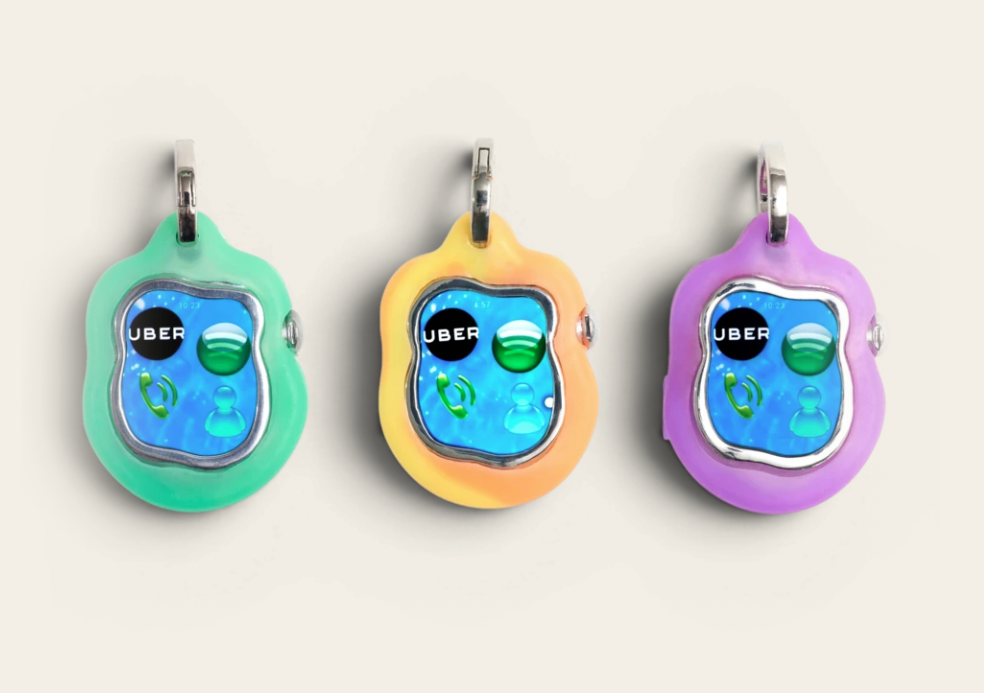
Meet the Amoeba One, a tiny keychain phone that looks like a Tamagotchi wandered into a cellphone store and decided to stay.
It has a wavy screen, colorful silicone body, built-in carabiner and a camera that swivels around. It’s strange-looking. A little ridiculous, even.
I kind of love the idea.
But the interesting part isn’t how small it is. It’s what the people behind it want to leave out.
A Phone That Doesn’t Want All Your Attention
The Amoeba One is being developed by a small team led by Cody Jones, a computer science student at Skidmore College in upstate New York.
The idea has been in development for roughly two years. In February 2026, Jones earned second place and a $10,000 prize in Skidmore’s entrepreneurship competition, where he demonstrated a working prototype of his minimalist phone.
Not bad for a college project.
The team launched its Kickstarter campaign on October 13, 2026, with a modest $25,000 funding goal.
It reportedly reached that goal in just 27 minutes.
By mid-November, the campaign had attracted more than 4,000 backers and raised over $480,000. Apparently, quite a few people are interested in the idea of carrying around considerably less phone.
And that’s really the pitch.
Instead of another smartphone designed to keep us looking at it, Amoeba One is supposed to handle the essentials without inviting us into an endless cycle of notifications, social media and mindless scrolling.
Imagine that. A phone that actually wants you to put it away.
So, What Can This Little Thing Actually Do?
Despite its size, the Amoeba One isn’t quite a traditional dumbphone.
It’s being developed around a customized version of Android, with a carefully selected collection of apps intended to make everyday life possible without a conventional smartphone.
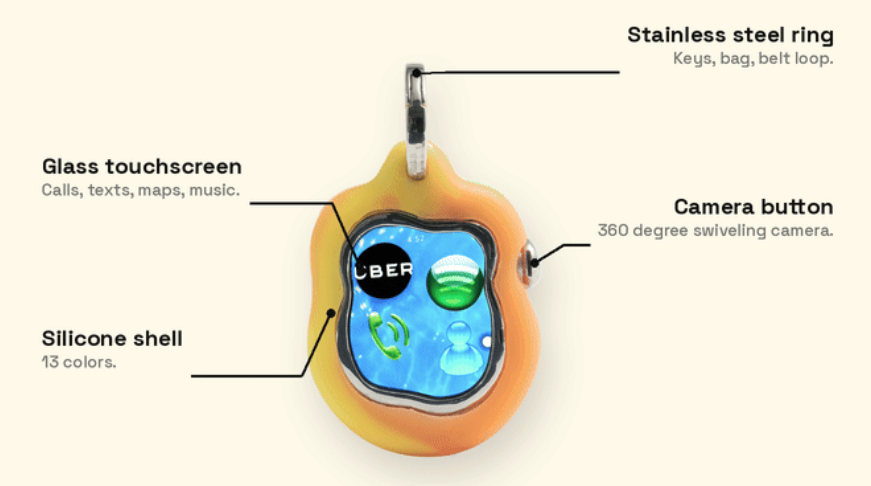
The planned functionality includes calling, texting, maps, ridesharing, music and basic utilities.
Spotify is part of the appeal, along with services like Uber and navigation tools. That means you could theoretically leave your regular smartphone at home, listen to music, find your way around and still get a ride when you need one.
The company is also developing its own curated app store, with the possibility of expanding functionality over time.
One particularly interesting prospect is Libby, the app that lets you borrow ebooks and audiobooks from your local library. It’s been discussed as a possible future addition rather than a confirmed launch feature. On a device this small, audiobook listening would certainly make more sense than trying to read a novel on its little screen.
It’s a smart approach, assuming the software delivers.
The hardware is equally unconventional. The phone uses a physical 4G SIM card, with Bluetooth, Wi-Fi and USB-C charging. There’s a 360-degree swiveling pop-out camera, a 1,000mAh battery and a glass touchscreen wrapped in a soft silicone shell with a steel inner structure.
The team is also experimenting with different keyboard layouts and voice-to-text functionality to make typing on that tiny screen more manageable.
And then there’s the design.
Alongside the standard green, orange and purple models, there are swirling color combinations, spiky shells and surprise editions.
It reminds me of a time when buying a phone meant choosing something that actually looked different from everybody else’s.
Before every device became essentially the same black rectangle.
The Big Question: How Much Is Too Much?
One of the more fascinating aspects of the Amoeba One discussion is the number of people asking for additional apps.
Spotify makes sense. So do maps, ridesharing and perhaps banking.
But what about WhatsApp? Mobile payments? More messaging platforms? Other popular services?
Those questions are showing up in conversations around the project, along with practical concerns about battery life, carrier support and whether typing on such a small display will become frustrating.
And they point to a dilemma.
How many features can you add to a minimalist phone before it stops being minimalist?
It’s the same challenge facing just about every modern dumbphone.
People want to disconnect. They just don’t want to lose the conveniences they’ve come to depend on.
I get it.
We’ve spent plenty of time at Enter Safe Mode exploring old cameras, standalone music players, PDAs and other devices that do less than our smartphones. Not because they’re necessarily better technology, but because sometimes doing less is precisely the point.
The Amoeba One attempts something different. Instead of asking us to go back to 2005, it’s trying to bring some of that simplicity forward.
And perhaps its biggest limitation will turn out to be its greatest feature.
Promising? Yes. Proven? Not Yet.
Here’s the important part: Amoeba One is still a Kickstarter project.
I haven’t tested one, and this isn’t a buying recommendation.
Campaign pricing has been hovering around $100 to $130, depending on the version and reward tier. The estimated delivery date is October 2027, nearly a year after the campaign ends.
There are still unanswered questions about real-world battery life, network compatibility, app performance and how well everything will work on such a tiny screen.
And although the campaign’s fundraising success is encouraging, crowdfunding is not the same thing as buying a finished product.
Manufacturing a phone is complicated. Manufacturing an unusually small phone with custom software and a distinctive design may be even more complicated.
Still, I’m intrigued.
Maybe the Amoeba One becomes a clever alternative for people who want to leave their regular smartphones behind occasionally. Maybe it’s a first phone for someone who doesn’t need social media. Or maybe it’s simply a fun secondary device for music, calls and the occasional text.
Of course, there’s also the possibility that it ends up being another quirky gadget that looks better in pictures than it works in real life.
Either way, I’m glad somebody is experimenting.
Because at Enter Safe Mode, the goal isn’t to abandon technology.
It’s to find technology that knows when to leave us alone.
And this little phone might be a step in the right direction.
Curious? You can explore the Amoeba One Kickstarter campaign. We’re following the concept, not endorsing the product.

Drew G. Rosen is a New York-based writer and marketing executive. As an advocate for “Ping Minimalism,” he buys, tests, and occasionally resurrects vintage gadgets, distraction-free writing tools, and forgotten technology to see whether yesterday’s devices still have a place in today’s always-connected world. Sometimes, the old stuff really is better.