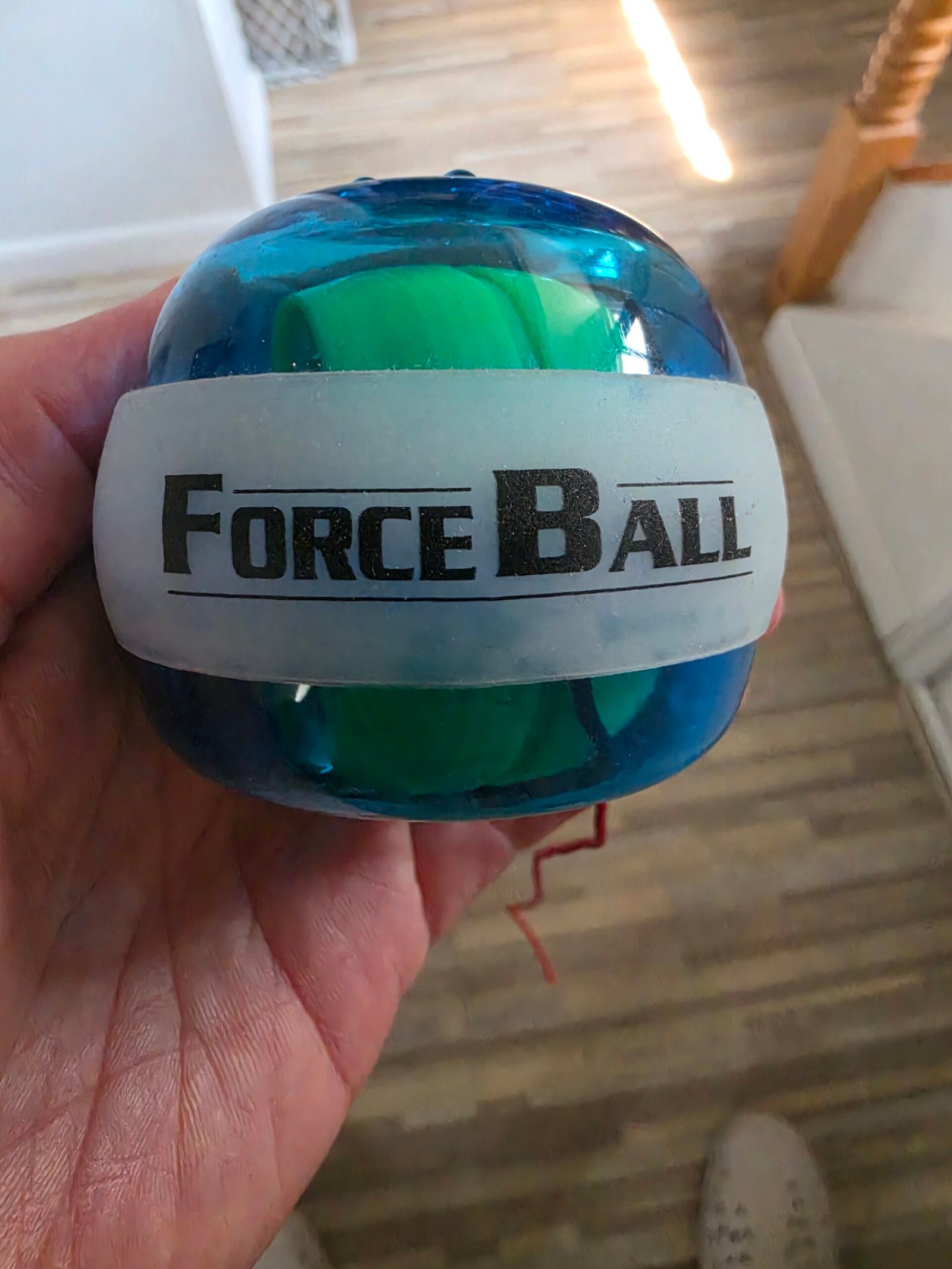
A force ball (you’ll also see it sold as a Gyro Ball or a Powerball) is a mechanical wrist exerciser that runs entirely on angular momentum. No batteries. No Bluetooth. No companion app begging you to upgrade to Premium. It fits in a desk drawer, costs about twenty bucks, and it will drag your attention out of the screen and back into your own forearm in roughly four seconds.
I hit the wall around 3 PM yesterday.
You know the one. Eyes burning from a spreadsheet I’d been staring at since lunch (it’s corporate budget season!), and that dull ache starting up in my right wrist, forged by twenty years of holding a computer mouse.
My eyes were burning, too. So instead of more clicks and screentime, I opened the top desk drawer and pulled out my FORCE BALL.
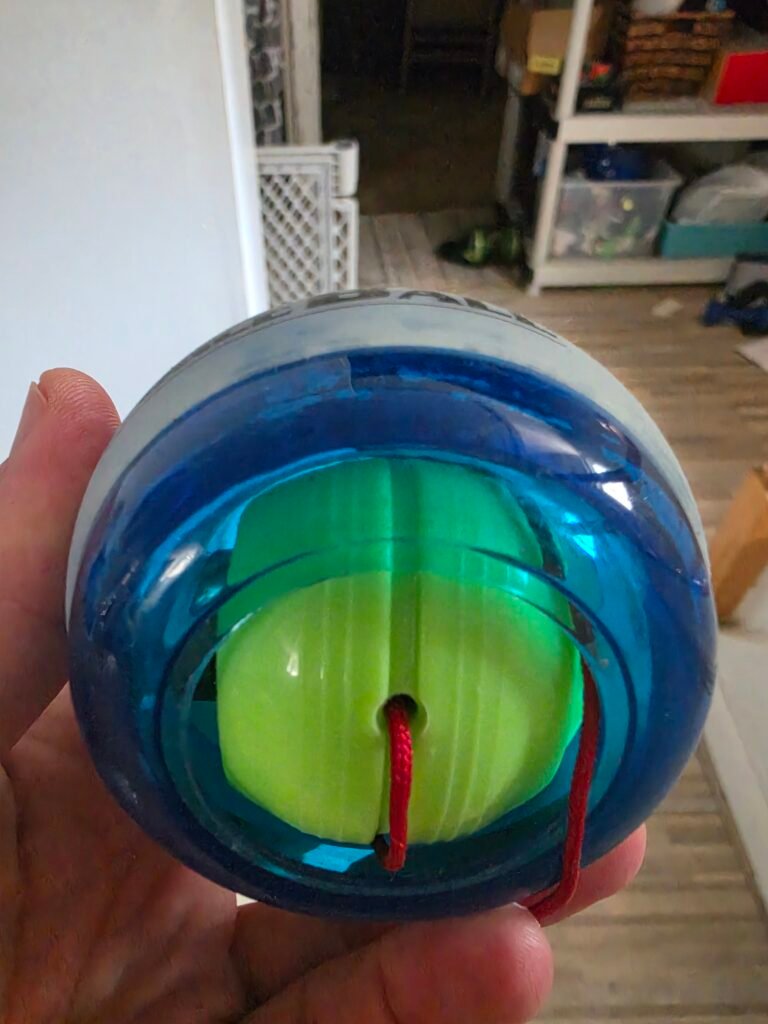
I wound the small red rope, let ‘er rip, and let the rotor go, rolling my wrist back and forth. The thing started to hum. The faster I spun, the louder it got and the heavier it felt, like the ball was fighting me. And somewhere in there I stopped thinking about capital expenses, because I physically could not think about anything except keeping this piece of plastic alive.
That’s the beauty of using a gyro ball. It hijacks your attention on purpose, just enough to give your brain a reset.
The Specs
- Product: Gyro Ball / Force Ball
- Power Source: Angular momentum (zero batteries)
- Primary Function: Grip, wrist, and forearm strength
- Peak Output: Up to ~30 lbs of torque at speed
- Distraction Level: 0%
- Price: ~$15 – $30
Starting the Engine
This is not a medicine ball or a slam ball. There’s no weight to swing around. Inside the shell is a heavy rotor spinning on a track, and all the resistance you feel comes from fighting its gyroscopic precession. Which is a fancy way of saying it gets harder the better you get.
Getting it going is its own little skill.
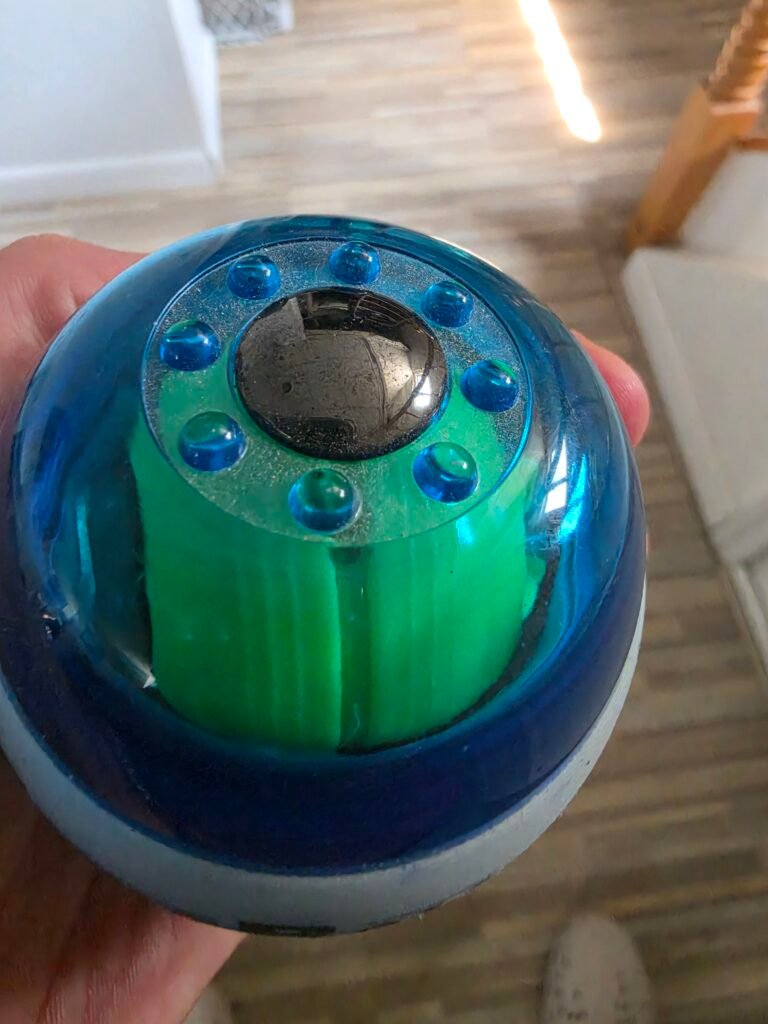
1. Wind it up. Spin the internal rotor with your thumbs, following the arrows, until you feel it wind tight against the track. (Some older models use a pull string, like starting a lawnmower. Objectively cooler.)
2. Find the rhythm. Let the rotor go and immediately start making small, tight circles with your wrist. You aren’t spinning the ball so much as feeding it, matching its rotation and handing it a little momentum on every pass. Get lazy, and it dies in your hand.
3. Speed up. As you lock in, the ball spins faster and the resistance climbs on its own. No dials, no settings. At full tilt this thing is putting around 30 pounds of torque into your wrist.
There is no way to half-pay-attention to this. That’s the point. Your phone is designed to be usable while your mind is somewhere else. The Gyro Ball is the opposite, it quits the second you check out.
5 Ways to Use It Without Leaving Your Desk
One piece of gear, no gym clothes, no changing rooms, no walking anywhere.
The Standard Wrist Spin
Arm straight out, palm facing down, slow circles. This is your baseline. Hits the forearm extensors, which are the muscles that take the beating on heavy typing days.
The Palm-Up Flexor Spin
Same motion, but flip your hand so the palm faces the ceiling. The load slides off the top of the forearm and onto the flexors underneath. It feels completely different, and it’s noticeably harder.
The Fingertip Hold
Don’t wrap your palm around it. Cage the spinning ball with your fingertips only and move your hand in a slow stirring motion. This one isolates the finger tendons. If you play guitar or climb, you’ll feel it in about twenty seconds.
The Door-Knob Pump
Lock your wrist rigid. Hold the ball on its side and twist from the elbow in a half circle, exactly like you’re wrenching open a rusted doorknob. All forearm.
The Bicep Pulse
Arm bent at 90 degrees, tucked near your ribs, ball spinning. Gently pulse the wrist back and forth. The gyroscopic feedback travels up the arm and lights up the bicep without a single dumbbell in the room.
Pros & Cons
Pros:
- It takes your whole brain. The hum and the vibration keep you present whether you want to be or not. You cannot check Instagram with a live gyroscope in your hand.
- It’s pocketable. Jacket, backpack, desk drawer, glovebox.
- Zero connectivity. No charging cable, no firmware update, no data going anywhere, no account.
- It’s actually therapeutic. Low-impact work for wrists worn down by years of desk life.
Cons:
- The learning curve is real. Your first few attempts will die in your hand, and you will feel dumb. Give it ten minutes.
- The noise. At speed, the rotor puts out a whine. Deeply satisfying if you’re the one holding it, less so for the guy at the next desk in an open-plan office.
The Verdict
We keep trying to solve analog problems with software. Your hands hurt, so you buy a wearable that charts how much your hands hurt.
Skip it. Buy the twenty-dollar ball, keep it in the drawer, and when the afternoon wall hits, wind it up instead of reaching for the glowing rectangle. Five minutes of chasing a spinning rotor around your wrist does more for your head than fifteen minutes of scrolling ever has.
Forearms of steel is just the side effect.
Frequently Asked Questions
What muscles does a Gyro Ball work? Depending on arm position and grip, it hits the fingers, wrist, and both the forearm flexors and extensors, and you can push the feedback up into the biceps and shoulders. Most people buy one for grip strength or wrist rehab.
Does a force ball need batteries? No. Some models have LED lights, but those run off the kinetic energy of the rotor itself. The resistance is 100% manual angular momentum. Nothing to charge, ever.
Is the Gyro Ball good for carpal tunnel? Gyroscopic wrist exercisers are a common recommendation for low-impact rehab work — slow, gentle rotations increase blood flow and strengthen the tendons around the joint without the static load of weights. That said, if you’ve got real nerve pain or numbness, talk to an actual hand therapist before you start spinning a 30-pound-torque device on it.
How long should I use it for? Start with two or three minutes per hand and stop before anything feels strained. It’s easy to overcook a small joint with a tool this cheap and this fun.